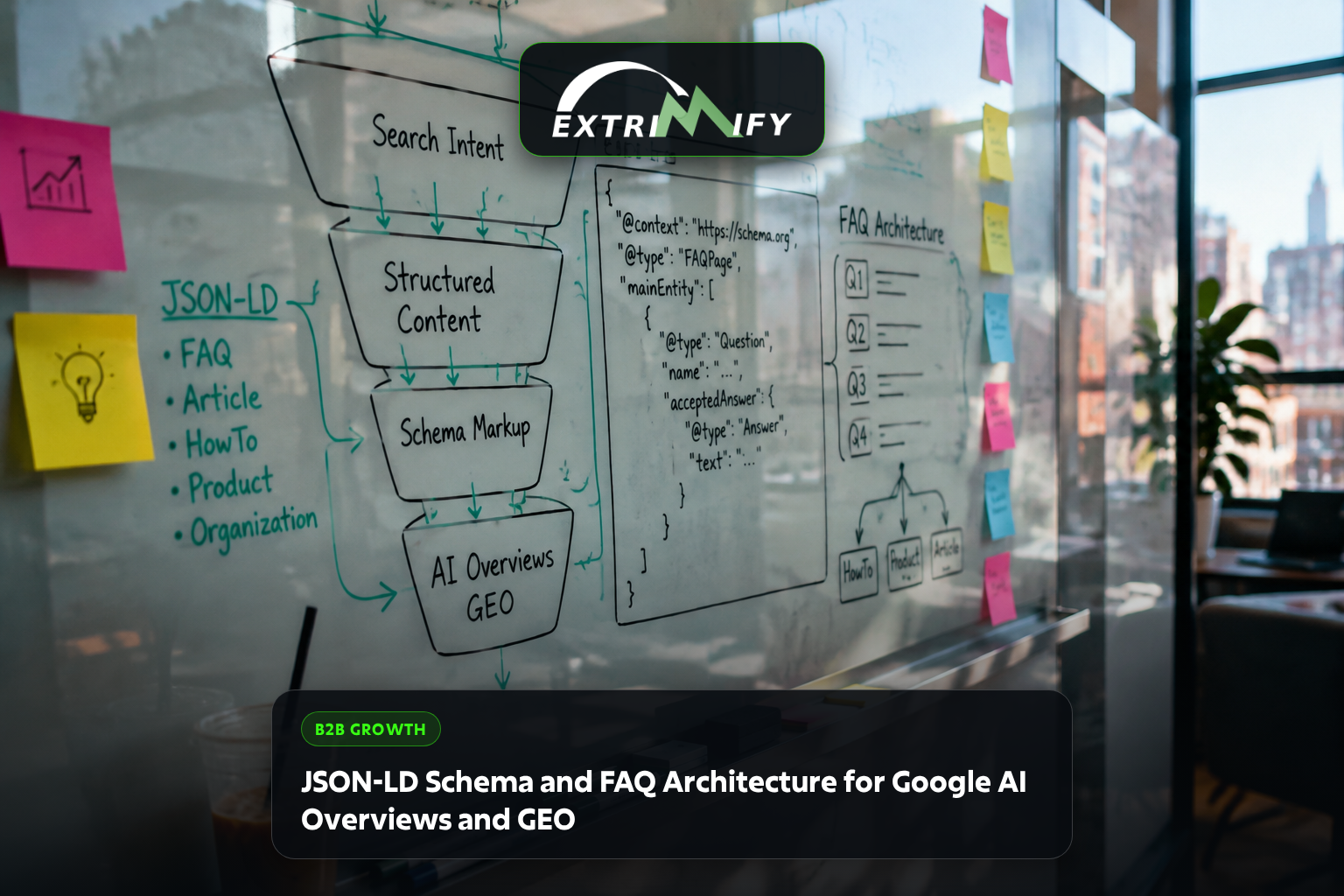
JSON-LD Schema and FAQ Architecture for Google AI Overviews and GEO
Answer capsule: Start with the buyer question and the page that should answer it, not with a schema checklist. Make the answer visible, add JSON-LD that accurately describes it, validate the implementation, and review indexing, relevant visits, and qualified conversations within seven days. Structured data supports clarity; it does not guarantee an AI Overview.
What decision should a B2B team make first?
Choose one page that matters to a real buying decision: a service page, solution page, or substantive guide. Name the audience, problem, offer, and next step in plain language. Then decide which structured data types accurately represent that page. This order matters because schema describes content; it does not create a strategy or make an unclear offer understandable by itself.
Ignore the temptation to mark up every possible entity, publish a large block of generic FAQs, or treat an AI citation as the only success metric. Do not add fields that have no visible counterpart on the page. Google's structured data policies require markup to be relevant and representative of visible page content, and eligibility for a search feature is not a promise that it will appear.
Make the first weekly task deliberately narrow: one audience, one page, one key question, and one primary measurement. If the team cannot agree on what the page offers, pause implementation and clarify the positioning first. Extrimify's Strategic Diagnosis can help connect audience, offer, and content before technical work begins.
What does JSON-LD schema do, and what does it not do?
JSON-LD is a format for expressing structured information about entities and relationships, such as an organization, service, article, or question and answer. Search systems can use structured data to understand page information. It is not a ranking switch, an AI Overview submission mechanism, or a replacement for trustworthy, useful page content.
Treat markup as a clarity layer. The visible page answers the buyer; JSON-LD describes relevant information in a machine-readable form. A B2B service page should explain who the service is for, what it includes, how the engagement works, and what outcomes are in scope. Mark only information that is accurate and represented on the page. Avoid implying that a particular schema type guarantees a specific search presentation.
Google's guidance makes an important distinction between following technical requirements and receiving a rich result. Therefore, success is not simply “schema exists.” Check whether the page is accessible, valid, indexed, useful, and attracting relevant attention. Build the content and measurement foundation using Extrimify's method, rather than assembling types without a business purpose.
Does Google still use FAQ schema?
FAQ structured data can describe questions and answers, but that does not mean every site will receive an FAQ rich result or more visibility. Eligibility and search appearance are controlled by Google's current policies and systems. Treat FAQ schema as an accurate description of useful page content, not as a guaranteed route to more SERP space or AI citations.
Write FAQs from questions that buyers actually ask: who the service is for, what the process involves, what the client needs to provide, and how the options differ. Give direct, complete answers. Keep the answers visible on the page and consistent with the markup. Do not create thin question blocks just to repeat target phrases or add claims the page cannot substantiate.
A FAQ section supports the page; it should not replace the main explanation. Answer a recurring question in a clear paragraph first. Then assess whether structured markup is appropriate under current guidelines. The same buyer language can inform focused execution through BOOST, while keeping the website, LinkedIn content, and sales conversation aligned. BOOST engagements run 4 to 8 weeks, a delivery cadence rather than a promise of results.
How does AI work in Google Search in this context?
Search systems crawl and index information, interpret queries, and organize results. AI Overviews are part of the search experience, but a business cannot assume that JSON-LD alone determines whether a page is selected for an AI-generated answer. The practical response is to publish accessible, useful, accurate content and make the page's subject and entities easy to understand.
That is why GEO is not a schema trick. Visibility in answer experiences depends on a broader set of signals and content qualities, including clear positioning, relevant expertise, useful structure, and alignment with the searcher's intent. For B2B, visibility itself is not pipeline. A useful page should connect to distribution and follow-up, including a consistent point of view on LinkedIn B2B.
Do not infer causation from one AI answer or screenshot. Record the query, date, market, and page, then repeat observations in comparable conditions. Search interfaces can vary. A log of recurring observations is more useful than a blanket claim that a particular schema guarantees AI visibility.
How can I add schema markup without creating technical debt?
Begin with the page. Confirm that its visible content is accurate, that service details match the rest of the site, and that the page is available to search systems. Choose schema types that describe what is actually there. Implement JSON-LD in the way that fits the content management system, then test before and after publication. Use Google Search Console and appropriate validation tools to inspect technical issues, while keeping technical validity separate from editorial quality.
Use a simple weekly sequence. On day one, choose a page and buyer question. On day two, review visible content, fill material answer gaps, and confirm service details. On day three, define the markup and the source of truth for each field. On day four, publish and validate syntax, errors, and warnings. On day five, check accessibility and consistency between markup and page text. At week's end, record index status, impressions, relevant visits, and qualified inquiries. Use the GEO Checker as a practical checkpoint in that workflow.
A seven-day review is useful for implementation progress, not proof that schema caused a business outcome. Establish a baseline from Search Console and site analytics, record the date, and compare after a week. Check whether the page is accessible and indexed, whether search data is appearing, and whether relevant users are visiting or asking better questions. If there is no movement, inspect intent and distribution before adding more markup.
How do diagnosis, BOOST, LinkedIn, and GEO connect to pipeline?
Diagnosis identifies which audience, need, and value proposition deserve priority. The page then explains the offer and addresses buying questions. JSON-LD describes that content accurately. Distribution helps the right audience encounter it, while GEO checks whether the business and its subject matter are represented clearly across relevant answer experiences. Strategic Diagnosis typically takes 2 to 4 weeks; BOOST typically takes 4 to 8 weeks. These are canonical delivery durations, not outcome guarantees.
On LinkedIn, publish a useful insight that leads to the relevant page instead of making broad claims about AI. On the website, provide enough detail for a buyer to assess fit. In GEO work, monitor relevant queries and improve gaps using evidence. All channels should support the same commercial conversation: whom you help, what problem you address, and what a sensible next step looks like.
For measurement within seven days, select three signals in advance: markup validity, page accessibility or index status, and an early business signal such as relevant visits or qualified inquiries. If there is no traffic, examine intent and distribution. If traffic is irrelevant, sharpen the audience and message. If there is interest without inquiries, inspect the offer and next step. Review results to structure measurement, or contact Extrimify to plan a connected system from visibility to execution.
What should the team verify before closing the task?
Check that every marked-up detail matches visible content, service information is consistent, validation errors have been addressed, and the page is accessible. Confirm that FAQ answers help a human reader and do not imply guaranteed positions, exposure, or revenue. Record the publication date and version so later observations can be interpreted against a real change.
Keep technical, visibility, and business measures distinct. Valid code is a technical condition, not a pipeline result. An impression is a visibility signal, not proof of demand. A qualified inquiry or advancing sales conversation is a business signal, but it still needs context and sufficient observation. The durable approach is to learn from evidence, improve the page and distribution, and repeat the check rather than react to every search display change.
FAQ
Does Google still use FAQ schema?
FAQ structured data describes questions and answers, but adding it does not guarantee a rich result or an AI Overview appearance. Keep answers visible, useful, and consistent with current Google guidance.
How does AI work in Google Search?
Google systems crawl and organize information and respond to queries in context. JSON-LD can describe page information in a structured way, but does not guarantee selection for an AI-generated answer.
What does JSON-LD schema do?
It expresses information about entities and relationships, such as an organization, service, or FAQ, in a structured format. It supports understanding but does not replace useful visible content.
How can I add schema markup to my website?
Choose a page and schema type that match visible content, implement JSON-LD, validate it, and monitor accessibility, indexing, and relevant outcomes. Never mark up information that is absent from the page.
- Full article on Extrimify -
Read the original article on Extrimify: https://extrimify.com/en/blog/json-ld-schema-architecture-for-ai-overviews
Extrimify B2B growth services:
About the author
- Turning B2B LinkedIn & AI Visibility (GEO/SEO) into an Automated Executive Meeting Engine 24/7.
Comments
Join the discussionNo comments yet. Be the first to comment.